
We often talk about safety as if we all mean the same thing by it. As if it’s a concept we understand rationally and can simply decide to feel. But the truth is more uncomfortable than that. There is often a painful mismatch between the words we use to describe safety and what our bodies actually experience as safe.
As Stephen Porges once put it:
“If you want to improve the world, start by making people feel safer.”
Not telling them they are safe. Helping their bodies feel it.
To understand trauma, we have to start there; with the body, not the story
Wired for survival before we’re born
Our nervous system begins forming astonishingly early. Long before we have memories, language, or conscious choice, the foundations of our internal safety system are already being laid.
From the outer embryonic layer, he ectoderm, the nervous system develops. By just a few weeks into pregnancy, the neural tube forms, which later becomes the brain and spinal cord. Those connections between brain and spinal cord remain fundamentally the same throughout our lives.
In other words: the system that decides whether you feel safe, threatened, relaxed or on edge today was already under construction before you ever took your first breath. That matters. Because trauma doesn’t start where memory starts.
Your internal communication network
The nervous system is your body’s internal communication network. Its job is simple and ruthless: to keep you alive. It continuously gathers information; from inside your body and from the outside world; sorts it, prioritises it, and decides where energy needs to go. Muscles, organs, attention, digestion, rest. Nothing is random.
Crucially, the nervous system always functions as one integrated whole. There is no neat separation between body, emotion and thought. They are different expressions of the same system. And most of this happens without your conscious involvement.
In fact, roughly 80% of what we do is driven by our autonomic nervous system, not by deliberate choice.
Two pedals, one system
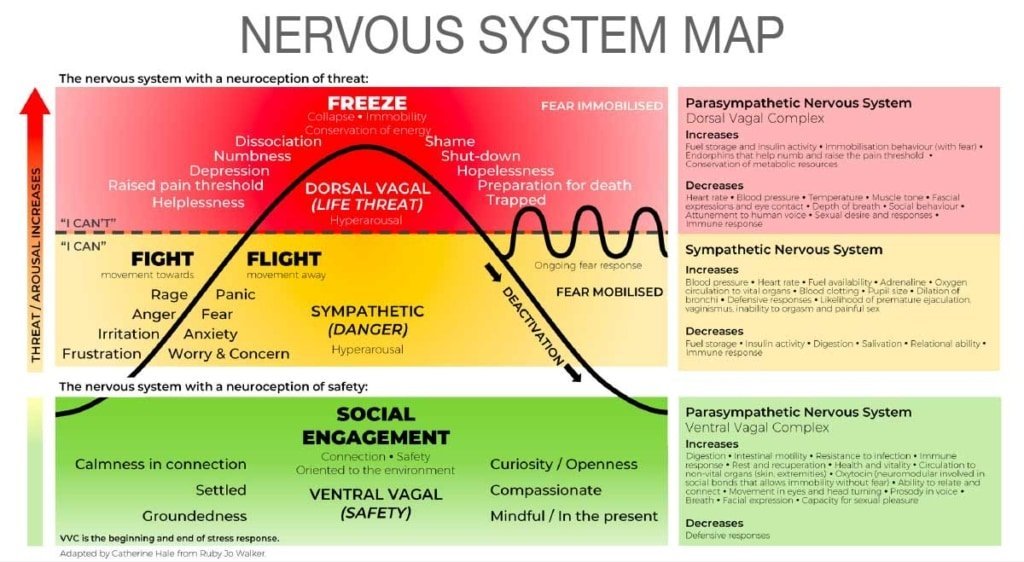
The autonomic nervous system has two main branches. You can think of them as two pedals in the same car.
The sympathetic nervous system — the accelerator
This is the system of action, mobilisation and survival. It prepares you to work, fight, flee, respond. Heart rate increases, breathing quickens, digestion slows, blood is redirected to the muscles. Adrenaline and noradrenaline do their job. This system is not the enemy. It’s essential. Without it, you wouldn’t survive danger; or life.
The parasympathetic nervous system — the brake
This is the system of rest, repair and recovery. It slows the heart rate, deepens the breath, stimulates digestion, supports sleep, healing and regeneration. The vagus nerve plays a key role here. This system allows you to land. To digest not just food, but experience.
A healthy nervous system moves fluidly between these two states, depending on what the moment requires.
Regulation versus survival lock
When the accelerator and the brake are well coordinated, we can tolerate frustration, disappointment and stress without losing ourselves. We can pause, feel, and choose how to respond. That’s regulation. Trauma changes this.
In a traumatic situation, the nervous system mobilises enormous survival energy. If that energy cannot be discharged; because the threat is overwhelming, prolonged, or inescapable, the system doesn’t get the signal that danger has passed.
So it does something paradoxical:
it presses the accelerator and the brake at the same time.
The body is flooded with survival energy, while simultaneously being shut down to prevent overload. The result is hyperarousal and collapse existing side by side. Tension, numbness, anxiety, exhaustion, disconnection; not as psychological flaws, but as physiological consequences. This is why trauma is not “over” just because an event has ended.
When the body never gets to stand down
If the nervous system remains stuck in survival mode for too long, its ability to discriminate weakens. Signals become distorted. Muscles stay tense. Digestion suffers. Sleep is shallow. The body remains alert even when there is no immediate danger.
Many people adapt by disconnecting from their bodies altogether. This isn’t pathology; it’s intelligence. Why would you want to inhabit a body that feels unsafe, painful or overwhelming? But disconnection comes at a cost. Without awareness of internal states, it becomes harder to regulate emotions, set boundaries, or feel grounded in the present.
Why body-based work matters
Because trauma lives in the nervous system, healing cannot rely on insight alone. Body-oriented approaches help the system complete what was interrupted: to discharge stored survival energy, to re-learn the difference between past and present, and to experience safety not as an idea, but as a sensation.
What has been learned can, slowly and patiently, be unlearned. Not through force, but through repetition, attunement and choice. When people begin to recognise their autonomic states; to know whether they are mobilised, collapsed, or regulated; confusion gives way to orientation.
You are not broken; your system adapted
Trauma is not a personal failure. It is a nervous system doing its best under impossible conditions. Your body didn’t betray you. It protected you; and may simply not have been shown how to stop yet.
Understanding the nervous system doesn’t fix everything. But it does something essential: it replaces self-blame with context, and shame with comprehension. And from there, real healing can begin.