Andreas Moritz was an author in the field of alternative medicine, best known for his book The Amazing Liver and Gallbladder Flush. His ideas about coffee enemas are part of a broader theory about liver cleansing and liver stones.
A coffee enema works roughly as follows:
- The caffeine is quickly transported to the liver via the intestines.
- This causes the bile ducts to dilate and increase bile flow.
- Coffee increases the production of glutathione S-transferase (GST), a detoxification enzyme, by hundreds of percent. This helps the liver to remove toxins from the blood.
- Toxins, bile residues, and liver stones then can be more easily excreted through bile.
- For this reason, he often recommended coffee enemas before or after a liver flush, so that the liver can eliminate waste more efficiently.
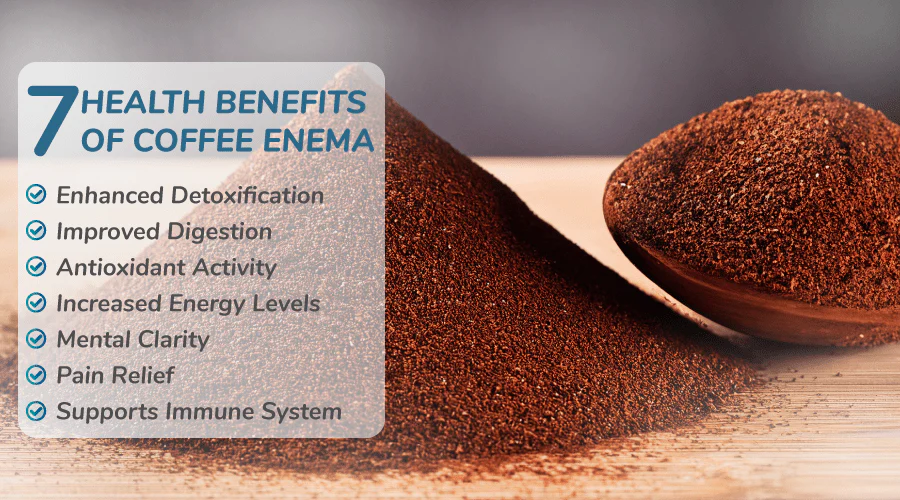
Moritz also described that a coffee enema would:
- relieve the liver;
- improve blood circulation through the liver;
- help empty the gallbladder;
- reduce headaches and nausea after a liver flush.
What did he base this on?
He referred to:
- the work of Max Gerson, who used coffee enemas within the so-called Gerson Therapy;
- older studies from the 1920s–1980s on bile secretion and liver enzymes;
- his own clinical experiences with clients.
Moritz did not see the liver only as an organ that breaks down chemicals, but as a kind of “storage place” for waste substances that would accumulate over decades. From this perspective, periodic liver flushes and coffee enemas seemed logical to him.